A pedestrian was struck and killed in the Rainier Valley this morning. It appears that a woman in her late 70s was crossing against the signal and was struck by a vehicle and died at the hospital.

A pedestrian was struck and killed in the Rainier Valley this morning. It appears that a woman in her late 70s was crossing against the signal and was struck by a vehicle and died at the hospital.
 A reader reports a photo of a broken push button at Lake City Way & NE 20th Ave.
This broken crosslite button on the Lake City Way crossing at NE 20th demonstrates why having any crosswalks defaulted to Don’t Walk is a bad idea for pedestrians. I’ll send word to the city via that handy link you recently posted, let’s see how long it takes to repair. I’d imagine a stoplight at that location would take no more than 24 hours. In the meantime, the next crosswalks in either direction is 5+ blocks away.
He was right, SDOT fixed the crosswalk button by the next day. SDOT deserves credit for the quick response, but it’s unfortunate that the signal broke to begin with. This type of issue would be less common if all crosswalk signals would be automatic in walkable areas.
From the Times:
A 34-year-old sex offender with a lengthy rap sheet was sentenced to more than 10 years in prison Friday for running over and killing a 91-year-old Capitol Hill woman last year.
Shipp’s blood-alcohol level was measured at 0.16 percent, twice the legal limit, after the crash, according to police. Shipp, police said, denied being drunk, saying he had taken a 500-milligram Vicodin pill several hours earlier.
[Judge] Yu told Shipp his two-page criminal history persuaded her to hand down a harsh sentence. The judge questioned whether Shipp ever had learned a lesson from time he previously spent behind bars.
It’s unlikely the sentence would have been nearly as severe if the negligent driver were not a repeat offender. Currently, a vulnerable users bill is being considered in committees in the state congress, which would increase penalties for vehicular negligence. Seattle Bike Blog has a good write-up of the status of HB 1339 and SB 5326.
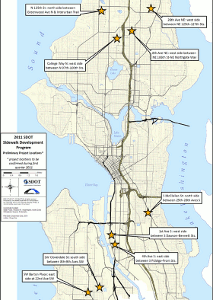
Pedestrians can look forward to 9 new sidewalks this year. SDOT carefully prioritizes sidewalks by looking at conditions along the roadway as well as location in the city. Roads that are unpleasant to walk along because they lack sidewalks and have high traffic volume would score high on the first category. Areas in the city that are well-used by pedestrians and are important for pedestrian mobility score well on the second criterion. The streets that will be receiving new sidewalks this year scored high on both.
SDOT is currently planning to build sidewalks in the following locations in 2011:
- N 125 th Street between Greenwood Ave N & the Interurban Trail (north side)
- 26 th Avenue NE between NE 125 th-127 th Streets (west side)
- 8 th Avenue NE between NE 106 th St & NE Northgate Way (west side)
- College Way N between N 97 th-100 th Streets (west side)
- S McClellan Street between 25 th & 26 th Avenues S (north side)
- 1 st Avenue S between S Dawson & Bennett Streets (west side)
- 4 th Avenue S between S Fidalgo & Front Streets (east side)
- SW Cloverdale Street between 8 th-9 th Avenues SW (south side)
- SW Barton Place at 22 nd Avenue SW
Westlake Streetcar Plaza (aka McGraw Square) was reopened in a ceremony yesterday. The SDOT blog has coverage of the ceremony. From the Times:
Mayor Mike McGinn, who presided over the dedication, said the plaza will create a pedestrian-friendly island in the heart of downtown Seattle. He said it’s one of three transportation hubs serving downtown.
The new plaza, at the end of the South Lake Union streetcar line, between Olive Way and Stewart Street, was built with a $900,000 grant from the state Department of Transportation.
Officials envision it filled with trees and tables, even food vendors.
Its location will make it easier to travel around downtown, with connections from the streetcar to the Monorail, light rail and the downtown bus tunnel, said those at the dedication.
There is a lot of potential for this plaza. At a minimum, the area has instantly become more pedestrian-friendly, but its success as a public space will be determined based on how well it is used.
As the trees that dot the area sprout leaves in spring and grow larger over the years, the space will likely feel more inviting and less exposed. People will spend time in the space to wait for the streetcar, but the plaza likely won’t become a lunchtime gathering spot until the city changes its restrictive food cart policies.
Anyway, it will be interesting to see what happens. Anyone else have any thoughts?
If the green street on Maynard Avenue doesn’t get you to take a stroll through the International District, maybe the Storefronts Seattle project will. From Storefronts Seattle:
From September 2010 to February 2011, local artists will be using vacant retail spaces in the Pioneer Square and Chinatown-International District neighborhoods to display their artwork, house their creative enterprises and establish artist residencies.
Visit the Storefronts Seattle website for a printable walking map to take with you. These exhibits are in place until the end of the month.
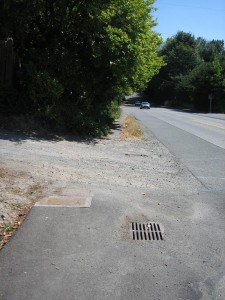
A reader sent in photos of a new asphalt walkway on 15th Ave NE between 94th and 97th St. This project was requested by the community and funded by the Neighborhood Projects Fund.
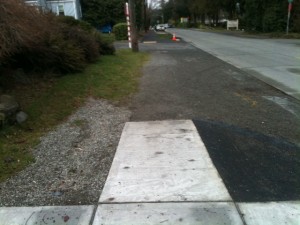
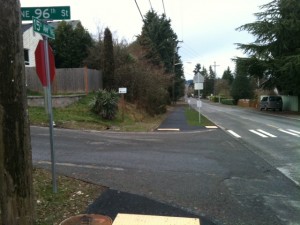
Better than nothing I suppose, but assuming they survive the elements over the next 5-10 years, what’s to prevent them from becoming parking strips for local residents and their guests? Nor do they connect with the nearest bus stop. Meanwhile we hear about the ‘war on cars’. I think that war was lost years ago.
While the new asphalt walkway certainly isn’t as good as a legitimate sidewalk, it does appear to be better than what was there before.
The Bridging the Gap transportation levy approved by voters in 2006 continues to pay dividends for pedestrians. Last year, SDOT announces, the levy paid for 15 blocks of new sidewalk and repairs to 23 blocks of existing sidewalks. 40 intersections received new pedestrian countdown signals. There were also 42 crossing improvements and 630 crosswalks re-striped.
Since 2006, 69 blocks of new sidewalk have been constructed and 89 blocks have been repaired. 3,312 crosswalks have been re-striped. The program will continue through 2016, so we should continue to see many important improvements to pedestrian infrastructure.
2011’s Worst Intersection in Seattle… isn’t an intersection at all. At its cross streets that don’t actually cross – John, Thomas, Harrison, and Republican – Aurora presents a nearly half-mile long barrier to pedestrian movement. Aurora Ave is a human-made scar through Seattle that obstructs the flow of people – nowhere worse than between the dense Lower Queen Anne / South Lake Union areas.
View 2011 Worst Intersection in Seattle in a larger map
The street grid will eventually be reconnected, but not until the completion of the Alaskan Way Deep Bore Tunnel boondoggle in 2015 or 2016. Councilmember Tim Burgess earlier requested that WSDOT open crossings at the completion of the Mercer Corridor Project in 2014.
Regardless of when these intersections are restored, it’s too long to wait. In the three year period between April of 2005 and March of 2008, five pedestrians were struck within the 0.4 mile length of Aurora between Denny and Mercer – this is more than were struck in the 4 miles immediately to the north between Mercer and Green Lake.
Opening these crossings to people on foot would make it significantly easier to access Seattle Center and for workers on either side to access more lunch and happy hour options. The closed intersections mean that many trips take an extra 10 minutes of walking, which is inconvenient enough to discourage people from walking at all.
Reopening the intersections could improve safety for vehicles as well. There were 72 collisions on Aurora from Thomas to Republican during the time period referenced above. Vehicles here move 40-60 miles per hour, so providing signalized intersections would protect motorists as they turn onto Aurora.
I’m not optimistic that we’ll see changes anytime soon. This section of Aurora carries roughly 60,000 vehicles daily, and signals would delay these vehicles. Highway 99 is under the jurisdiction of WSDOT, an organization whose goal for decades has been to move more cars, and adding a signal here – where Aurora is essentially a freeway – would go against their deeply-ingrained traffic engineering standards. 60,000 drivers could generate a lot of complaints, sadly more than a few concerned pedestrians can.