Wallingford Architecture Walk

Via Feet First – there’s a walk this coming Saturday the 11th at 10 am:

Join the Wallingford Community Senior Center and Sustainable Wallingford on the annual Wallingford Neighborhood walk series. Participants of this walk will explore the architecture of homes around the neighborhood.

Join Wallingford Walks on the second Saturday of each month from May through September. The walks vary in distance, duration and theme and will be led by knowledgeable guides who are familiar with the topic and the neighborhood. For more information about upcoming walks, contact Nora Erwin-Stewart by emailing norah@wallingfordseniors.org or Katheen Cromp by emailing kcromp@wallingfordseniors.org or by calling 206.-461.7825

Share

Seattle ranked one of the safer US cities for pedestrians

Transportation for America has analyzed pedestrian safety data across the country to rank the most dangerous cities in the country for pedestrians and Seattle was ranked 46th out of 52.

The Seattle PI’s Traffic and Transportation News blog has a good writeup:

In a news release from Transportation for Washington, Mayor Mike McGinn credits the city’s pedestrian master plan and Complete Streets ordinance, which requires new roads be designed with bicyclists and pedestrians in mind. The city’s Bridging the Gap levy has helped pay for a number of improvements since it was passed in 2006. At the state level, the Legislature this year passed a “Vulnerable User’s” bill, which boosts penalties for negligent drivers who kill or maim bicyclists, pedestrians and other “vulnerable roadway users.”

Still, the report notes that 398 pedestrians were killed from 2000 to 2009 in Seattle’s Metro area.

While traffic deaths have dropped nationally by 27 percent over the last decade, pedestrian deaths have been reduced by less than half that. “Despite the magnitude of these avoidable tragedies, little public attention – and even less in public resources – has been committed to reducing pedestrian deaths and injuries in the United States,” according to the report. “On the contrary, transportation agencies typically prioritize speeding traffic over the safety of people on foot or other vulnerable road users.”

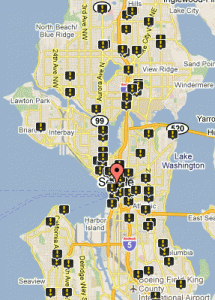
Transportation for America also has a searchable and interactive map of pedestrian fatalities.

Share

Open houses for construction projects

An open house is coming up for improvements to Orcas Ave S as well as for the Mercer West Project:

Improvements proposed for Mercer Street from Dexter Avenue N to Elliott Avenue W

The Seattle Department of Transportation (SDOT) is hosting an open house at Seattle Center, June 8, to talk about the preliminary designs for the Mercer West Project, including the underpass at Aurora Avenue and the two‐way conversion of Roy and Mercer streets between Fifth Avenue N and Queen Anne Avenue N. In addition, SDOT will show recommendations for West Mercer Place and West Mercer Street, based on the evaluation of alternatives and input from stakeholders. The project team will be available from 4:30 to 7 p.m. in the Rainier Room (within the Northwest Rooms Plaza) to solicit
ideas from the public and answer questions about current preliminary design concepts for:

– A wider Mercer Underpass at Aurora Avenue North;
– Converting Mercer and Roy Streets from one‐way to two‐way operation;
– And improving intersections, street connections and bike access.

Open House Details:
Seattle Center (at the intersection of Warren Avenue North and West Republican Street)
Northwest Rooms Plaza: Rainier Room
4:30 – 7:00 p.m.

The Mercer West Project would complete the City’s vision for a direct, two‐way connection between I‐5 and Elliott Avenue West, continuing where the Mercer East Project leaves off. The proposed improvements include:
• Widening Mercer between Dexter Avenue N and Fifth Avenue N, including the underpass at Aurora to provide three lanes in each direction, left‐turn lanes, wider sidewalks, and a bicycle path;
• Converting Mercer Street to two‐way operation with two lanes in each direction and turn pockets between Fifth Avenue N and Queen Anne Avenue N;
• Converting Roy Street to a two‐way street with one lane in each direction and bicycle lanes between Fifth Avenue N and Queen Anne Avenue N;
• Creating a new Sixth Avenue N connection between Mercer and Harrison Streets; and;
• Closing Broad Street to re‐connect the street grid between Ninth Ave N and Fifth Ave N.

For more information on the Mercer West Project, visit:
www.seattle.gov/transportation/mercer_west.htm

The Seattle Department of Transportation (SDOT) is holding an open house on June 16 to discuss pedestrian improvements proposed for South Orcas Street.

Date: Thursday, June 16
Time: 6:30 to 8 p.m.
Where: Dearborn Park Elementary School
2820 S Orcas Street

A new sidewalk, curb and street trees are proposed for South Orcas Street between Beacon Avenue South and 28th Avenue South. If funding becomes available, these improvements could continue on the south side to 32nd Avenue South. There is also a potential for bicycle improvements.

Also at the meeting, project staff will explain the pedestrian and bicycle programs that are coming to Dearborn Park Elementary School.

Share

Infrastructure improvement updates

Here’s a rundown of current and recently completed SDOT projects that promote pedestrian mobility:

Share

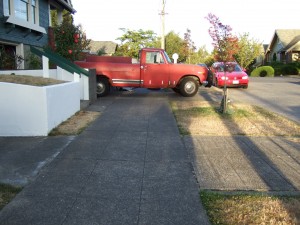
Blocking us from walking: Old red truck

This truck was spotted completely obstructing the sidewalk in Wallingford:
Red truck blocking sidewalk

We’re running a series to point out drivers who obstruct pedestrian mobility in the city. This includes drivers obstructing crosswalks, vehicles parked on sidewalks, delivery trucks blocking intersections, and Metro buses running the light.

Examples of vehicles obstructing pedestrian and bicycle movement are common throughout the city. And, if you’re a driver, you’ve probably found yourself in the wrong position from time to time as well. By calling out the most egregious examples, hopefully we can remind all drivers to be more careful how they use their vehicles.

Upload your photo via our contact form and they may be featured on the blog.

Share

Q & A with City Council President Richard Conlin

Richard ConlinWalking in Seattle is running a series to showcase the perspectives of prominent walkers in the city. This week’s Q&A is with Seattle City Council President Richard Conlin:

Walking in Seattle: Where is your favorite place in the city go for a walk?

Richard Conlin: I have a favorite route that leaves my house in Madrona, goes through Frink and Colman Parks, and returns along Lake Washington. I walk home from City Hall frequently as well, usually along Madison and then Union or nearby back streets.

WiS: What do you like most about walking in the city of Seattle?

Conlin: Greenness and flowers, many people out on the street.

WiS: What is the top thing you’d like to see improved for walking in the city of Seattle?

Conlin: Increased maintenance on sidewalks and stairways.

WiS: One last question – be honest, do you wait for the crosswalk signal?

Conlin: If the coast is clear for a couple of blocks, I won’t wait. Also, hate being at crossings where the crosswalk doesn’t correlate with the green light unless you were there to push the button when the signal changed.

If you’d like to nominate a local walker to be included in this Q & A series, or volunteer to participate, please use our contact form.

Share

Natural drainage systems in sidewalk construction

In Crosscut, Roger Valdez looks at the impacts of traditional sidewalks on the environment. A Washington State Department of Transportation study unsurprisingly shows a benefit from installing sidewalks.

Here’s the key paragraph from the study:

The results provide early evidence in the potential effectiveness of sidewalks to reduce CO2 and VMT [vehicle miles traveled], in addition to a mixed land use pattern, shorter transit travel and wait times, lower transit fares and higher parking costs. Sidewalk completeness was found to be marginally significant (at the 10 percent level) in reducing CO2, and insignificant in explaining VMT.

In this sense the term “marginally” might read as “small.” But in a research context “marginally significant” also means sidewalks can make a difference along with other factors to significantly reduce CO2 emissions.

However, pavement is impermeable, blocking rainwater from being absorbed by the ground and redirecting it to the storm sewers that send it to Puget Sound.

After it rains, water hits all that pavement and it starts rolling around, picking up the petroleum drippings from cars, pesticides from lawn care products, and a legion of other things that end up harming fish and other creatures trying to survive in urban creeks and streams. Ultimately, all that water winds up in the Puget Sound, where the Partnership for Puget Sound says at least two species of salmon are threatened with extinction because of stormwater runoff.

Valdez supports natural drainage systems, like the one installed on NW 110th St. These narrow the roadway and include landscaping to collect rainwater runoff, reducing the amount of rainwater and pollutants channeled into the Sound.

The project that Valdez references was constructed by Seattle Public Utilities whereas most sidewalks are constructed by SDOT.

However, the city’s 2009 Stormwater Code requires SDOT to consider green stormwater infrastructure. SDOT spokesperson Marybeth Turner says:

This means that where space is available and it is technically feasible, elements such as bioretention swales, porous sidewalk, and new street trees are required to be installed adjacent to the new sidewalk in the planting strip between the sidewalk and street. These measures are meant to infiltrate or reduce the surface water generated from the impervious surface of the sidewalk before it reaches the gutter and eventually the drainage system and Puget Sound.

There are several current SDOT sidewalk projects that include green stormwater infrastructure elements. On these projects, SPU is “providing guidance with respect to maintenance requirements and direction on standards requirements.” These projects include NE 55th and Ravenna intersection improvements, Linden Ave N Complete Streets Project, and “numerous neighborhood sidewalk projects funded by the Bridging the Gap transportation initiative,” according to Turner.

While these sidewalks take cues from the green drainage designs that SPU has developed, this design cannot be applied everywhere. “The space may not be available, the pollutant loading too great, the soils may not be conducive, and there are in most cases numerous other utilities which may be in conflict,” Turner says

Still, it’s good to know that the city is working to limit negative side effects of new sidewalk construction. Now, if only they could build more of them.

Share

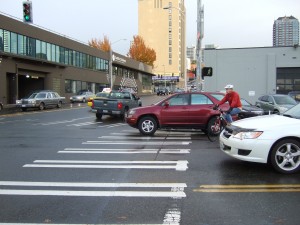
Blocking us from Walking

We’re starting a new series to point out drivers who obstruct pedestrian mobility in the city. This includes drivers obstructing crosswalks, vehicles parked on sidewalks, delivery trucks blocking intersections, and Metro buses running the light.

Examples of vehicles obstructing pedestrian and bicycle movement are common throughout the city. And, if you’re a driver, you’ve probably found yourself in the wrong position from time to time as well. Still, by calling out the most egregious examples, hopefully we can remind all drivers to be more careful how they use their vehicles.

Upload your photo via our contact form and they may be featured on the blog.

Driver blocking crosswalk

Share

Summer Streets on Alki this Sunday

Alki Ave SW will be fully closed to vehicle traffic between 63rd Ave SW and 56th Ave SW for the Summer Streets program. It starts at 11 and includes special demos, kids activities:

With the streets car-free and fun-focused expect the unexpected…random yoga; intermittent acts of dance; sidewalk chalk…outside the lines! So plan on playing in the street this weekend – the Summer Streets – and…bring your creativity!

It’s everybody’s street. Imagine the possibilities.

Share

Contributors Welcome

Since Walking in Seattle was started in January of 2010, we’ve averaged about 4.5 new posts per week. That may slow down a little bit as I will have some other obligations over the next few months, like visitors, travel, and more work than normal at the job that I get paid for doing. Others are welcome to contribute to the blog to help keep up the pace.

One relatively easy thing that could be done is to link to and analyze pedestrian news from other sites. There is also an opportunity to do original reporting, which could be a good unpaid opportunity for any journalism student, or anyone who may want to give it a try. Thoughtful and considerate editorials and commentaries may also be welcome.

Feel free to send this link on to others who may be interested. If you want to contribute or have questions, please fill out our contact form.

Share