Archive for the 'information' Category

Page 8 of 12

479 Vehicle-Pedestrian Crashes in 2009

Erica at PubliCola shares some statistics from SDOT in 2009:

  • Car collisions with pedestrians were also down, but they remained more common than bike collisions, with 479 crashes (11 of them fatal) last year alone. Sixty-eight percent of the time, the pedestrian was hit in a crosswalk (just 8 percent of all crashes were pedestrians crossing intersections against the signal).
  • Although pedestrian and bike collisions were the most likely collisions to be fatal (accounting for 11 of 24 fatalities), overall, driving a car remains the most dangerous way to get around. Ninety-three percent of all accidents in 2009 were between cars or cars and stationery objects (like parked cars, which accounted for 24 percent of all car-on-car crashes, or things like phone poles and street signs, which made up another 6 percent).
  • Finally, the data suggest that if you’re going to get drunk, just stay home. Although just one cyclist was hit by a drunk driver in 2009, five drunk cyclists were involved in crashes, along with 11 pedestrians. (Two pedestrians “had taken medication,” one was under the influence of drugs, and one was “apparently asleep,” according to the report.

While it’s good that pedestrian accidents declined in 2009, accident and fatality numbers are still way too high. 251 of these accidents were at least partially the fault of drivers. With driving on the decline, hopefully these accidents will continue to decrease. But more vigilant prosecution of dangerous driving, as well as some changes to protect pedestrians (e.g. disallowing right-on-red in some locations), could help make Seattle a safer place to walk.

Share

Year of Seattle Parks

The City of Seattle has 403 parks.  One intrepid resident is on a quest to visit all of them in one year:

I know what you’re thinking. All the parks in the city of Seattle in one year? Piece o’cake. I thought the same thing, too…. this will be a fun, easy project. I’ll visit one park every week, I thought. Write a few notes about them and throw my musings up on a blog.

Well, much to my surprise when I visited the city’s web site I discovered that Seattle has 403 parks. No kidding.

Now, I’ve lived in Seattle for several years and really enjoy visiting parks for picnics, swimming and walking. And, I considered myself pretty knowledgeable about the parks in this city.

I had no idea.

There are parks I have literally never ever heard of. Like Albert Davis Park and Amy Yee Tennis Center. And, that’s just a couple from the “A”s. How about the tempting Beer Shiva Park and Benefit Playground? Or, the curiously named Condon Way Centerstrip and Counterbalance Park: An Urban Oasis. No clue about those either.

A Year of Seattle Parks contains information on each park visited so far along with photos and suggested walking routes. Stop by to find some new places to walk in the city.

Share

“Walking” and “Seattle” becoming more popular

A few weeks ago, Google released a neat tool that allows you to see how frequently words appear in literature published since 1800.

After a significant decline in popularity in the first half of the 20th century, “walking” is appearing more often in literature now than ever before. Seattle is also on the rise. Click here for Google’s Ngram Viewer.

"Walking" and "Seattle" appearing more often in literature

Share

Map of all Seattle Stairways

There is a map that shows all stairways in the city of Seattle, at around 650, including suggested walking routes and more information.

This was part of a blogger’s New Year’s resolution to map, climb, and photograph all stairways in the city in 2010. Seattle All Stairs has a map of all the stairways in the city as well as 29 different walks to take.

Share

Seattle Stairway Walks Blog

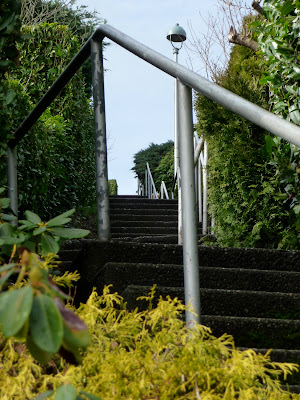
Laurelcrest StairsFor those of you who love to get out and participate in urban hiking, Jake and Cathy Jaramillo’s Seattle Stairway Walks blog shares some great routes for exploring Seattle’s pedestrian stairways. The blog shares walking routes on stairways in various parts of the city and includes history, photos, and more. Here’s an excerpt from a recent post about a walk through Laurelhurst:

On this stairway walk you might try to imagine the childish voices of the Duwamish kids who played here 150 years ago, when this little peninsula jutting into Union Bay was a seasonal Indian camp. You might think of the sound of heavy machinery gnawing on the last of the old growth forest, when Yesler Town with its gritty little mill stood here in the 1890s. Or you could consider the ‘thwack’ of a golf ball being struck on Seattle’s first course, laid out here around the same time as Yesler Town was built.

All of this is almost unimaginable nowadays. By 1910, when Seattle annexed “Laurelhurst,” it was a small community of less than 20 homes, isolated by water and rough terrain. Now it’s known as the neighborhood where Bill Gates Jr. grew up, and where Senators Magnuson and Evans retired. It’s very family-oriented, too: the percentage of households with kids is twice that of Seattle as a whole, and many residents who grew up here returned eventually to raise families of their own.

Laurelhurst is sited spectacularly on winding, hilly streets overlooking Union Bay and Lake Washington. You’ll explore a lengthy stairway ending at the Lake Washington shore, right next to the Laurelhurst Beach Club (you can join if you live south of NE 50th Street). You’ll discover a hidden stairway disappearing down a shadowy arbor just off someone’s driveway, and pay a visit to an unexpected pocket park tucked between shorefront homes. If you do a stairway walk here in April, you might be lucky enough to witness the carefully tended landscaping exploding into flower, saturating the neighborhood with sweet perfume.

The blog has appeared in Sunset magazine and the West Seattle Herald, and is a great part of Seattle’s growing walking movement.

Share

Total Crisis Panic Button

Total Crisis Panic Button

Total Crisis Panic Button by Jason Eppink

Some crosswalk buttons in LA have been labeled Total Crisis Panic Buttons. According to the artist:

The Total Crisis Panic Button initiative replaced Los Angeles crosswalk instruction signs with more relevant and useful instructional graphics. (Nobody walks in Los Angeles, and who doesn’t know how to use a crosswalk anyway?)

I can’t think of anywhere in Seattle that has signs for a crosswalk push button (not even a sign with a slightly less authoritarian bent), but maybe I just overlook them. This is an open thread.

Share

Pedestrian safety laws being enforced downtown

Enforcement actions have begun downtown to keep pedestrians safe as part of the Holiday Pedestrian Safety Campaign.

As part of the Holiday Pedestrian Safety Campaign, targeted enforcement efforts by the Seattle Police Department will occur at high collision locations in the Center City area from December 29, 2010, to January 19, 2011.

The main goal of enforcement is to deter unsafe behavior by drivers, pedestrians and bicyclists, and to encourage people, whether they are driving or walking, to obey traffic laws and share the road safely. The effort will not detract from other policing duties or require additional funding, but will be part of the regular duties of the Seattle Police Department’s Traffic Section.

Drivers and pedestrians are both at risk of being cited for breaking any of these laws:

SMC 11.66.060 Blocking intersections and crosswalks
No person who is responsible for the operation of any railroad train or car shall stop the same within an intersection or on a crosswalk except to avoid accident or upon direction of a peace officer.

SMC 11.53.400 Further limitations on overtaking and passing
Whenever any vehicle is stopped at a marked crosswalk or at any unmarked crosswalk at an intersection to permit a pedestrian to cross the roadway, the operator of any other vehicle approaching from the rear shall not overtake and pass such stopped vehicle. (RCW 46.61.235(4))

SMC 11.50.270 “Walk” pedestrian-control signal
Pedestrians facing a walking person symbol signal may cross the roadway in the direction of the signal. If pedestrians have begun to cross a roadway while facing such a signal, all approaching vehicle operators shall stop to allow them to complete their crossing.

SMC 11.50.280 “Don’t walk” pedestrian-control signal
Pedestrians facing a steady or flashing hand symbol signal shall not enter the roadway, but if pedestrians have begun to cross before the display of either signal, vehicle operators shall stop to allow them to complete their movements.

It’s good to see enforcement like this, even if it is only for a small part of the year.

Share

America Walks

DC’s StreetsBlog has a good profile of the walking advocacy organization America Walks:

People tend to identify most strongly with things that set them apart. If everyone’s doing something, it hardly seems worth calling attention to the fact that you do it too.

Which may be part of the reason it’s been hard for pedestrian advocacy organizations to build a strong identity around walking.

America Walks is the only national organization dedicated to pedestrian rights and walkability. The fifteen year-old organization supports community-based walkability movements, such as Seattle’s Feet First. America Walks is putting together a national coalition of organizations that support pedestrian mobility, including the American Heart Association and the Rails to Trails Conservancy, and predicts expanding from 70 coalition members today to 500 by 2012.

They also hope to gather 25,000 signatures for their vision statement:

By 2020, walking in everyday life is embraced across America. Streets and neighborhoods are safe and attractive public places that encourage people of all ages, abilities, ethnicities, and incomes to walk for exercise, recreation, and transportation. Walkable community policies promote health, economic vitality, environmental sustainability, and social equity.

DC StreetsBlog concludes:

If that’s the future, it’s also the past. After all, as America Walks points out, “In 1969 walking made up 40 percent of all transportation trips, but in 2008 walking trips decreased to 11 percent.” Although walking is good for our heart rates and waistlines, modern road design can make it hazardous to our health: in the past 15 years, 76,000 pedestrians have been killed.

“We need to create places where you feel safe and comfortable walking along the street and even in the street, playing in the street,” says Bricker. “Crossing the street needs to be easy, accessible and safe.” He points to simple additions like crosswalks, raised median islands, and countdown signals as innovations that immeasurably improve the pedestrian experience.

Funding for active transportation has risen dramatically from 0.1 percent of the federal transportation program in 1992 to 2 percent this year. Considering the fact that 11 percent of all trips are by foot, America Walks wants to make sure walking gets its fair piece of the pie.

And though creating a strong identity among walkers can be challenging, Bricker says, “We don’t hear people saying, ‘this is not important, walking is not part of the transportation system.’ People understand that walking is a fundamental part of life.”

Share

Seattle saved from network of highways

Central District News looked at how R. H. Thomson Expressway would have walled off the Central District from Lake Washington. This was posted in May of 09, but we just came across it.  The report shows how walkability in Seattle almost took a big blow due to over-ambitious freeway construction. A freeway master plan shows a Seattle criss-crossed with pedestrian-impeding highways. One in particular would have sliced through the Central District and included crossings only at a few major intersections:
View Thompson Expressway in a larger map

Head over to Central District News to read more and find out how activists were able to stop the project.

Share

People happier in walkable neighborhoods

This shouldn’t come as a surprise to residents of the 6th most walkable city in the country, but a recent study has shown that walkable neighborhoods have happier people:

People who live in walkable communities are more socially engaged and trusting than those who live in less walkable areas, says a new study from the University of New Hampshire.

The study buttresses other research that has linked a neighborhood’s walkability to its residents’ quality of life, notably improved physical and mental health.

The researchers scored 700 residents of three communities in New Hampshire on measures of “social capital” such as socializing with friends, civic engagement and trust in their community. They found those in neighborhoods with higher Walk Score ratings reported being happier and healthier and more apt to volunteer, work on community projects or simply entertain friends at home.

Share