Archive for the 'issues' Category

Page 6 of 9

Crosswalk closure on 15th Ave NE

A reader shares that a crosswalk on 15th Ave NE is closed:

The funny thing is, in the time it took me to take the pictures, 5 people crossed the street anyway. One guy even pushed the walk button and went down and stood in the driveway and waited for the light to turn red. What I really don’t get is why did SDOT leave the driveway open at all? The parking lot connects to the alley on the back side.
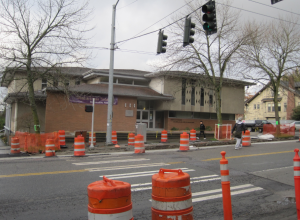
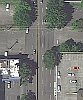
For reference, this is the crosswalk by 3925 15th Ave NE, in the middle of a roughly 2.5 block stretch of 15th Ave NE that for historical reasons has no cross streets. It’s a place that gets a good bit of foot traffic into UW main campus since it’s the most direct route from Stevens Court and Mercer Hall and a couple parking lots

It would be nice if SDOT made accommodations for pedestrians in this situation, but fortunately many people don’t let mere orange barricades keep them from their destination.

This work appears to be part of the 15th Ave NE Reconstruction between NE Pacific St and NE 55th St. Based on the online project schedule (which may not be accurate), the weekday work should finish this Friday and then the construction appears to be scheduled for completion at the end of this weekend.

Share

Vote for the Worst Intersection in Seattle

Note: The winning intersection has been announced.

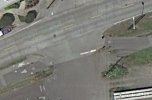
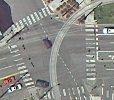
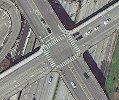
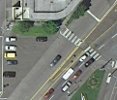
The nominations are in. In no particular order, here are this year’s nominees for Worst Intersection in Seattle (click on images for map):

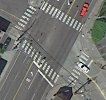
  1. Intersection at NE 45th St & 7th Ave NE 7th Ave NE and NE 45th – “The bizarre center-of-the-intersection crosswalk, the fact you have to wait three whole signal changes to cross catty-corner (which nobody does), the fact that it’s the only “safe” crossing of 45th for several blocks headed east (so you end up with mass jaywalking). Just awful.” (nominated by Tom F)
  2. Aurora and cross streets Republican, Harrison, Thomas, and John – “These intersections all suck for not existing, pedestrian-speaking. We have enough geographic barriers to movement in this town, we don’t need to create our own with concrete.” (nominated by Hans)
  3. Eastlake Ave & Fuhrman Ave Eastlake NE and Fuhrman E – “ear-crushing noise off I5, car drivers rushing to turn off or onto the University Bridge, which often means navigating around a ‘oh hey a pedestrian’ car stopped across the pedestrian walkway, which pushes you out into the Bicycle Lane, who in turn have their own troubles with cars failing to yield.” (nominated by Jeremy Mates)
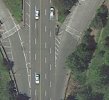
  4. Aurora Ave & Bridge Way exit Bridge Way exit off of Aurora – “Has the most dangerous sidewalk in the city. I believe many people would get hit there were people actually using it. It is a soft turn off of Aurora, so drivers come flying around at 50+ mph. Drivers can’t see if anyone is on the crosswalk and pedestrians can’t see if anyone’s coming toward it. To make matters worse, there’s a two foot drop from the sidewalk to the street, so if you saw a car was coming at the last minute, it wouldn’t be easy to get back to safety. When I’ve walked up Aurora this way, I’ve gone way out of my way to 38th to get back onto Aurora, rather than put my life on the line trying the direct path.” (nominated by NJL)
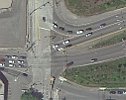
  5. Mercer St / I-5 on-ramps & Fairview Ave Mercer / I-5 ramps and Fairview – “Basically a 8-lanes of freeway onramp / offramp. Not only can’t you cross Mercer at all on the east side of Fairview, but if you’re on the north side of Mercer, there are no pedestrian signals to cross any street – you’ll have to walk a block back north to cross Fairview at Valley.” (nominated by Troy)
  6. Latona Ave & Pacific St Latona Ave NE and NE Pacific St – Pedestrians have to “dodge cars, large trucks AND bikes at this intersection. The Burke Gilman trail merges with the sidewalk at this intersection so you have large numbers of bikes, many moving fast, that must be avoided by pedestrians. The noise from the I-5 bridge makes any attempt to warn “on your left” impossible to hear. Large trucks entering and leaving Dunn Lumber have a steep hill that they must stop on before pulling across the Burke Gilman trail/sidewalk and turning onto Pacific. Vehicles on Pacific turning south on Latona must not only do the usual checks but also look over their shoulder for fast moving bikes on the Burke Gilman. A mess for all!” (nominated by pat)
  7. Westlake Ave & Valley St Westlake and Valley/Broad – “It is particularly dangerous if you are trying to cross Westlake on the north side of the intersection. It is a soft right turn for people traveling east on Valley and turning onto Westlake, so most don’t slow down at all or bother to consider there might be pedestrians who have the right of way. Also, the cross walk a block up Westlake is mostly useless, as no one ever stops for it.” (nominated by NJL)
  8. Pine St & Boren Ave near Capitol Hill / First Hill Pine and Boren – A very busy pedestrian intersection, with pedestrians exposed to the noise from the freeway below and surrounded on all sides with cars and concrete. “I keep hoping those overpasses are near their end-of-life so they can be replaced with something that buffers the noise, ideally with some vegetation.” (nominated by Tom F)
  9. Fairview Ave & Eastlake Ave Fairview and Eastlake – “The sidewalk vanishes into a parking lot. The parking lot itself is barely distinguishable from the road when it isn’t filled with cars.” (nominated by NJL)

[poll id=”6″]

Update: The winning intersection has been announced.

Share

Nominate your worst intersection in Seattle

Walking in Seattle is going to identify the worst intersection in Seattle, and you’re invited to submit nominations. Once nominations have been received, all readers will be invited to vote for the worst.

The worst intersection could be the most dangerous, or perhaps one with limited pedestrian crossings, poor signaling, or no curbs. Intersections like 23rd & Yesler or 12th & Madison are two intersections that might be worth nominating. Whatever qualifies as your “worst,” suggest it in the comments. The most nominated intersections and intersections with the most persuasive nominations will make it to the voting round.

Update: Time to vote!

Share

Sidewalks mostly remain open at Westlake Streetcar Plaza

Sidewalks around Westlake Streetcar Plaza have mostly remained open after the conclusion of the holiday construction moratorium.

We reported back in October that construction had closed the sidewalks around McGraw Square, significantly impacting pedestrian movement. However, those sidewalks were completely reopened to accommodate pedestrians during the holiday construction moratorium during the past few weeks.

Now that the moratorium has passed, the construction project is continuing. The sidewalks along 5th appear to be remaining open, however a concrete sidewalk along Stewart has not yet been poured, so that sidewalk has been closed again. The latest report from SDOT says that construction will be complete in early February.

Share

Central District News suggests road diet for 23rd Ave

In response to the pedestrian “death map” we published, Central District News offers safety suggestions to combat the disproportionately high number of fatalities in their neighborhood:

So what can be done to reduce collisions? On a personal level, try to cross hilly streets either at the top or bottom of the hill. Make eye contact with vehicle drivers when crossing to make sure they see you. When driving, remember that all intersections are crosswalks by default whether there is paint on the ground or not, and pedestrians do have the right of way.

They also suggest a road diet for 23rd Ave, one of the most dangerous streets in the neighborhood:

There are other tools the city has used to increase safety on streets like 23rd Ave (I will now put on my safe roads advocacy hat). Currently, 23rd is a four-lane road with few safe pedestrian crossings other than at stoplights (what I would call a highway design). Four-lane configurations make left tuns onto and off of these roads difficult for drivers. They also prevent the city from being able to install safe crosswalks in sections where there are no stoplights for several blocks.

With only 15,100 vehicles per day south of Madison (according to 2006 data, the most recent readily available for this road) 23rd Ave has similar traffic volumes to roads across the city that have recently been reconfigured to increase safety for all users. These so-called “road diets” often add a center right left turn lane and sometimes bike lanes while removing one travel lane in each direction. Though they have proven to decrease all road collisions dramatically without reducing vehicle capacity, some have been controversial

Share

“Death Map” shows “city hasn’t taken pedestrian safety in the Rainier Valley seriously”

Erica C. Barnett at PubliCola, responding to SDOT’s map of pedestrian fatalities first published at Walking in Seattle, calls for the city to do something about the high number of deaths on Ranier Ave S:

In five years—despite dire warnings from groups like Save Our Valley that surface-level light rail construction and operations would lead to a rash of pedestrian fatalities—there have been zero deaths in the past five years along Martin Luther King, Jr. Ave., where surface-level light rail opened in July 2009. In the same period, there have been seven deaths on or near MLK’s parallel street, Rainier Ave.

The correlation is no coincidence: As I’ve written before, Rainier Ave. is a pedestrian nightmare, a five-lane arterial where drivers speed along at 50 mph and where stoplights are as far as a mile apart. MLK, in contrast, has more stop lights, fewer lanes, and frequent pedestrian crossings, especially at light rail stations. According to the PI.com, Rainier is the most dangerous street in the city, with 61 reported car-pedestrian collisions between 2002 and 2006. The intersection of Rainier and 39th Ave. S. tied a several-block-long stretch of Aurora for the most jaywalking incidents (six) in the city.

The solution (as I’ve also written before) is to add more stoplights and lighted, marked crosswalks all along Rainier. As long as people have to walk a half-mile in each direction to get to the nearest stop light and back, people are going to keep jaywalking across Rainier, and people are going to keep getting hit. The pedestrian death map highlights what’s already obvious to anyone who walks, rides the bus, drives, or bikes along Rainier: The city hasn’t taken pedestrian safety in the Rainier Valley seriously, and it’s time for them to step up and do so.

Share

What’s on your pedestrian wishlist?

While it’s disappointing that the city council rejected proposed funding for the Pedestrian Master Plan, good infrastructure is only part of what makes for a walkable city. There are some things that can be done without millions of dollars for new sidewalks or crosswalk signals.

Here’s my low-budget pedestrian wishlist:

  • Reduce the number of sidewalks and crosswalks blocked for construction – Building construction has slowed and fewer sidewalks are blocked for private construction. Still, SDOT projects like McGraw Square and the Mercer Corridor project are inconveniencing pedestrians. Sidewalk and crosswalk closures negatively impact people on foot, who in some cases have to cross busy streets twice. In order to reduce the inconvenience to Seattle’s pedestrians, I’d like to see the city limit sidewalk and crosswalk closures.
  • No “push to cross” buttons anywhere with a WalkScore above 90 – Intersections where pedestrians have to push a button to cross are the default in suburban places like Puyallup. In walkable urban areas of Seattle, these buttons are out of place. While the buttons may make sense late at night or early on weekend mornings when signal cycles are short, the standard style of button gives no indication of whether it needs to be pushed to change the signal for pedestrians. During busy hours of the day people on foot shouldn’t be forced to wait minutes at an intersection because they didn’t push the button. Removing these buttons, or at least changing signals to automatically allow pedestrian movement, would be a powerful way to let pedestrians know that they are important and to improve pedestrian movement in Seattle’s most walkable areas.
  • No right on red anywhere with WalkScore above 90 – Drivers have to be aware of many things in order to turn right on red. Conflicts between walkers and drivers are inevitable in popular pedestrian areas. Disallowing right on red in Seattle’s most walkable areas would keep people on foot safer. Unfortunately, this would probably raise objections from drivers as it would reduce vehicle flow.
  • Issue citations to drivers who block crosswalks – There are some intersections where heavy vehicle traffic often blocks crosswalks (and cross-traffic). While I can empathize with drivers who proceed through the intersection not knowing that they’re going to get stuck, legal enforcement could help pedestrian movement (and vehicle movement too).
  • Recalibrate all countdown timers to allow for safe crossing – Some crosswalk signals start their “don’t walk” countdowns with only 6 seconds to go. Not all pedestrians can walk quickly enough to cross in the little warning time given. Some intersections in tourist-friendly areas (e.g. near Pike Place Market) already have very long countdowns. By adding more time to the crosswalk countdown in other parts of the city, slower-moving people will be able to cross intersections more comfortably and all pedestrians will have a better chance to make it through an intersection.
  • Re-direct loudspeakers at parking garages – Many downtown parking garages and alleys are equipped with loudspeakers directed at pedestrians that say “Warning: vehicle approaching”. Pedestrians have the right of way on the sidewalk, so shouldn’t drivers be warned that pedestrians are in the area instead of the other way around? Requiring garages to change their loudspeakers to ask drivers to watch for pedestrians would send the message that cars are not more important than people just because they are bigger.

We might see all of these wishes granted in a walkers’ wonderland, but in reality we won’t see any of these this year. And, in a car-oriented American city like Seattle, some of these measures would be controversial. Still, each of these wishes would help Seattle to reach its goal to become most walkable city in the nation.

So, what’s on your pedestrian wishlist?

Share

More support for pedestrian safety campaign

Since our article on SDOT’s pedestrian safety campaign, more local blogs have spoken out in defense of the controversial campaign, including PubliCola, Seattle Transit Blog, and Seattle Bike Blog.

Here’s a dancing, umbrella flash mob, using umbrellas as part of the safety awareness campaign:

Following this, King 5 reported that a local business owner wants to know why we didn’t have a dancing, street-shoveling flash mob to clean up the snow. (that’s a joke)

Seriously, though, SDOT is getting their $47,000 out of this safety awareness campaign. While some people may criticize it, more people know about the campaign and the safety umbrellas than would have been possible without mainstream media coverage. Even if it’s the umbrellas that are receiving all the attention, people across the city are now more aware of the risks to people on foot. Whether that awareness translates to safer driving and fewer collisions downtown, however, remains to be seen.

Share

SDOT’s pedestrian safety initiative critcized

SDOT is working to make downtown safer for pedestrians during the dark winter months as part of their Holiday Pedestrian Safety Campaign. There are more pedestrian collisions during the winter months as shoppers rush around dark downtown streets.

One way they are doing this is by providing bright umbrellas for pedestrians downtown to borrow. The umbrellas make people more visible to drivers and also serve as a visual reminder of the safety campaign, which also will use advertisements, posters, and other ways of getting people to think about safety.

However, some people aren’t happy with the campaign and feel that the $47k that SDOT is spending to reduce the risk of collisions would have been better spent on snow removal or in myriad other ways.

While the region’s response to Snowpocalypse 2010 (also known as snOMG) was underwhelming, the factors that contribute to Seattle’s snowpocalyptic tendencies are greater than what SDOT can solve, even if they took money away from safety initiatives like this.

It’s easy to second-guess how money is spent, but it’s not as easy to keep pedestrians safe in the street. This Holiday Pedestrian Safety Campaign takes a relatively small amount of money ($47,000 or 0.00015%0.015% of SDOT’s budget) and uses it to help stop collisions and potentially save lives.

SDOT makes a strong argument in support of the campaign:

So, as highlighted in Seattle’s Pedestrian Master Plan, changing behavior is one of the keys to making everyone safer, especially when traveling around downtown. It’s convincing pedestrians to look before entering the crosswalk and getting drivers to be more aware of people walking.

Some have argued that trying to change driver and pedestrian behavior is a waste of time and resources. However, to create a walkable city we must use all available tools to reduce the number and severity of crashes. That means engineering improvements, enforcement and education. Our campaign this year includes bus ads, posters, stickers, displays for merchants, umbrellas, publicity events and public service announcements. The money we are investing in this pedestrian awareness campaign is worth it if we prevent one collision or save one life.

Share

Westlake Streetcar Plaza sidewalks re-opened

We reported a few weeks ago that the sidewalks surrounding Westlake Streetcar Plaza / McGraw Square had been closed, significantly impacting pedestrian movement in the area. This project was expected to be completed prior to Thanksgiving, however it has been delayed “due to unforeseen site conditions and weather delays,” according to SDOT spokesperson Rick Sheridan.

The sidewalks and crosswalks have been re-opened, however, as work on site has stopped. Seattle has a holiday construction moratorium, disallowing construction downtown from Thanksgiving through January 1. This moratorium helps businesses downtown by reducing the impacts of construction to vehicle and pedestrian traffic during this busy time of year. It is because of this moratorium and to better support pedestrians during the holiday season that SDOT has re-opened sidewalks around Westlake Streetcar Plaza and constructed a temporary sidewalk along Stewart Ave.

However, due to the weather impacts and current work stoppage, project completion will be delayed by more than two months. Sheridan says, “We estimate the project will be completed and the square opened for public use by early February.”

For now, though, it’s good that pedestrian movement is being prioritized and the sidewalks are open. SDOT will likely at least re-close the temporary sidewalk along Stewart to pour new concrete. We will check in on the area early next year when construction continues to see if SDOT chooses to re-close the already-completed sidewalks.

Share